
TL;DR:
- Carpet discolouration often results from deeper causes like wicking, mineral deposits, or mould, not surface stains.
- Prevention involves prompt spill action, controlling humidity, and using appropriate cleaning methods to avoid permanent damage.
- Professional cleaning and early intervention are key to restoring or maintaining carpet colour in the Yarra Valley.
You scrub the stain, it disappears, and two days later it’s back. Or you notice a patch of carpet that’s gone an odd shade of yellow with no obvious explanation. Carpet discolouration frustrates homeowners across the Yarra Valley every day, and the assumption that a quick spot clean will fix everything is one of the most common mistakes we see. The truth is that discolouration often has causes running deeper than the carpet fibres themselves, from the padding beneath to the humidity in the room. This article breaks down those causes clearly so you can make smarter decisions about cleaning and maintenance.
Table of Contents
- What is carpet discolouration?
- Main causes of carpet discolouration
- How to identify and diagnose carpet discolouration
- Prevention and maintenance tips for lasting carpet colour
- A fresh take: Why most carpet discolouration is preventable with the right habits
- Get professional help for stubborn carpet discolouration in Yarra Valley
- Frequently asked questions
Key Takeaways
| Point | Details |
|---|---|
| More than stains | True carpet discolouration involves changes below the surface, not just surface marks. |
| Wicking explained | Stains that resurface are often caused by wicking, where contaminants move up from the padding as carpet dries. |
| Pet and water issues | Hard water minerals and pet urine can cause delayed, stubborn colour changes in carpets. |
| Prevention matters most | Acting quickly with spills, managing humidity, and choosing the right products helps prevent long-term discolouration. |
What is carpet discolouration?
Not every mark on your carpet is a stain, and not every stain becomes true discolouration. Understanding the difference is more important than most people realise, because the wrong treatment can actually make things worse.
A stain is a foreign substance sitting on or in the carpet fibres. Think red wine, coffee, or mud. Given the right approach, most surface stains are removable. Discolouration, on the other hand, refers to a change in the actual colour of the carpet fibres themselves. The fibres may have faded, yellowed, bleached, or become permanently altered by a chemical or biological process. No amount of scrubbing will reverse a colour change that’s happened at a fibre level.
Common signs that you’re dealing with discolouration rather than a removable stain include:
- Irregular fading in patches, particularly near windows
- A yellow or brownish tinge across a section of carpet
- Mottled or uneven colouring that doesn’t follow the shape of a spill
- Stains that return shortly after cleaning
- Discolouration that feels dry and shows no obvious residue
That last point is particularly important. One well-known phenomenon called wicking occurs when contaminants buried in the carpet padding or subfloor migrate upward through the carpet fibres as the carpet dries. The surface looks clean after cleaning, then a dark patch mysteriously reappears a day or two later. This isn’t a new stain. It’s the old one travelling back up.
Why does the root cause matter? Because professional stain removal techniques differ significantly depending on whether you’re dealing with a surface stain, a deep-set contaminant, or true fibre discolouration. Applying a standard spot cleaner to a case of UV fading does nothing. Scrubbing a wicking stain harder only pushes contaminants deeper.
| Type | Cause | Reversible? |
|---|---|---|
| Surface stain | Spill on fibre surface | Usually yes |
| Deep-set stain | Contaminants in padding | Partially, with professional treatment |
| True discolouration | Fibre colour change (UV, chemical) | Sometimes, often permanent |
| Wicking stain | Contaminant re-emerging from below | Yes, with correct deep cleaning |
Poor humidity stains prevention is also a factor many homeowners overlook entirely. High moisture environments create conditions where discolouration compounds over time.
Main causes of carpet discolouration
Now that you know what sets carpet discolouration apart, it’s time to dig into the most common culprits found in homes and properties.
-
Wicking from padding and subfloor. This is one of the sneakiest causes. Deep contaminants rise via capillary action through carpet fibres as the carpet dries. Old spills that were never fully extracted, flood water, or even construction residue can sit in the padding for months before working their way back up. Homes that have experienced any kind of water ingress are particularly vulnerable.
-
Hard water mineral deposits. The Yarra Valley draws water from catchment areas that can carry varying mineral loads. Hard water leaves mineral deposits in carpet fibres over time, creating a dull haze or chalky discolouration. This is especially common in areas where carpet is cleaned with unfiltered tap water and not thoroughly rinsed.
-
Pet urine and ammonia reactions. Pet urine is deceptively damaging. Fresh urine is acidic, but as it breaks down, it becomes highly alkaline. This chemical shift, combined with ammonia content, causes delayed yellowing in carpet fibres. Owners often treat the initial wet spot and consider it done, not realising the real discolouration arrives days or weeks later. Check out carpet cleaning for pet owners for targeted advice.
-
UV light and sun fading. North-facing rooms in Yarra Valley homes receive significant direct sunlight through winter and summer alike. Ultraviolet light breaks down the dye molecules in carpet fibres, causing gradual but permanent fading. This often appears as distinct lighter patches that correspond exactly to where sunlight falls at certain times of day.
-
Chemical reactions from cleaning products. Bleach-based cleaners, some deodorising sprays, and even certain wool-safe products can strip colour from carpet fibres. The reaction isn’t always immediate. Sometimes discolouration appears hours after applying a product, which makes it harder to connect cause and effect.
-
Mould and humidity. In a region with Yarra Valley’s cool, moist winters, mould growth beneath carpet is a real concern. Mould produces pigmented compounds that discolour fibres from the base up, and research on health impacts of mould reinforces why this issue deserves urgent attention beyond aesthetics alone.
| Cause | Speed of onset | Typical appearance | DIY fixable? |
|---|---|---|---|
| Wicking | Days after cleaning | Spot returns in original shape | Rarely |
| Hard water | Gradual | Hazy or chalky patches | No |
| Pet urine | Days to weeks | Yellow/brown tinge | Unlikely |
| UV fading | Months to years | Light patches near windows | No |
| Chemical reaction | Hours to days | Bleached irregular spots | No |
| Mould | Weeks to months | Dark mottling, musty odour | No |
Pro Tip: If you notice a stain returning within 48 hours of cleaning, stop re-treating the surface. Repeated scrubbing or overwetting makes wicking dramatically worse by introducing more moisture into the padding. Call a professional who can extract from depth.
A recent study found that carpet cleaning done with excessive water without proper extraction is one of the top reasons stains reappear, underlining why technique matters as much as effort. For longer term prevention, exploring stain resistant carpet tips is a worthwhile investment of your time.
How to identify and diagnose carpet discolouration
Once you know the main triggers, the next step is learning how to spot the difference between a stain and deeper discolouration so you can act accordingly.
-
Look at the shape. True spill stains tend to have a shape that follows the original spill, often irregular but logical. UV fading creates linear or rectangular patches near windows. Wicking stains reappear in exactly the shape of the original mark. Mould discolouration tends to spread outward in a roughly circular pattern.
-
Check for moisture. Press a dry white cloth firmly into the discoloured area. If colour transfers to the cloth, you’re likely dealing with a surface stain or active wicking. If the cloth comes away dry, the discolouration may be a permanent fibre change.
-
Smell the area. A musty or earthy smell points toward mould. A sharp ammonia odour suggests old pet urine. No smell at all, combined with fading near a window, points toward UV damage.
-
Test the edges. Discolouration that fades gradually from a bright area to a dull one typically indicates UV fading. Sharp, well-defined edges with no obvious spill pattern often point to a chemical reaction.
-
Check the age of the issue. Hard water mineral haze and UV fading develop over months or years and correlate with areas that receive regular water contact or sustained sun exposure. A sudden patch is more likely a chemical or spill issue.
“In many Yarra Valley homes we’ve visited, what the homeowner thought was a new stain turned out to be a case of wicking from a flood or spill that happened months earlier. The timing genuinely surprises people.”
When to call a professional: If you’ve done the checks above and still can’t identify the cause, or if the discolouration covers more than a small area, professional assessment is worth it. A trained technician can use moisture metres, UV lights, and pH strips to diagnose exactly what you’re dealing with before any treatment begins. Learn more about removing old carpet stains and when DIY approaches fall short.
Managing indoor moisture over the long term also plays a major role. There are long-term humidity solutions worth investigating if your home retains moisture through the colder months, which is common in the Yarra Valley’s hilly and heavily vegetated areas.
Prevention and maintenance tips for lasting carpet colour
Identifying the issue is only half the battle. Here’s how you can help prevent discolouration before it sets in.
Act immediately on spills. Blot, never rub. Press a clean cloth straight down to absorb as much liquid as possible before it reaches the padding. The faster you respond, the less chance the contaminant has to migrate downward and create a future wicking problem. This simple habit prevents a significant proportion of the discolouration cases we attend.
Here are the most effective prevention practices for Yarra Valley homeowners:
- Vacuum at least twice a week in high-traffic areas to prevent soil build-up that degrades fibre dyes over time
- Schedule a professional deep clean every 12 months, or every 6 months in homes with pets or young children
- Use door mats at all entry points to reduce the volume of outside dirt and moisture tracked onto carpet
- Apply UV-filtering window film in rooms with significant sun exposure to slow fibre fading
- Use only pH-neutral, carpet-safe cleaning products and always test in an inconspicuous spot first
- Run a dehumidifier through winter months in rooms prone to condensation or dampness
- Avoid overwetting carpet during any spot cleaning. Damp, not soaked, is always the goal
Pro Tip: Proper humidity removal techniques are especially relevant for homes in Healesville, Seville, and other higher-altitude Yarra Valley areas that experience prolonged damp periods. A cheap portable dehumidifier can extend the life of your carpet significantly.
Choosing the right cleaning agent matters enormously. Wool carpets and synthetic carpets react very differently to the same products. Always read the manufacturer’s instructions for your specific carpet type before applying any treatment. When in doubt, water alone is safer than the wrong cleaner.
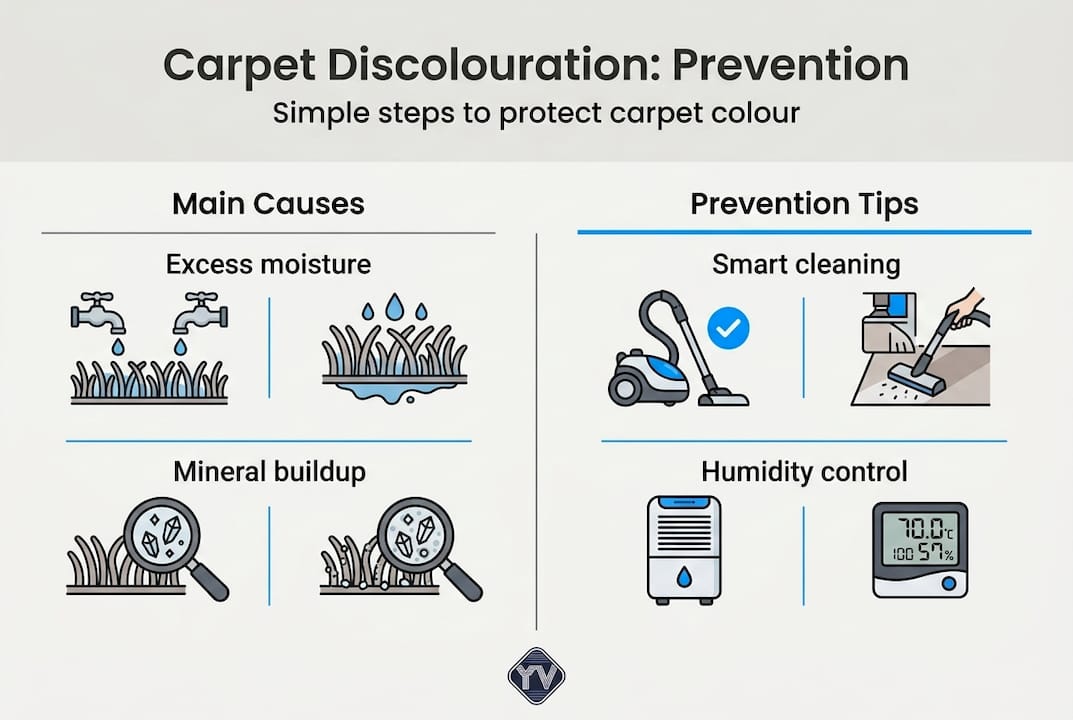
One often-overlooked strategy is ensuring carpet stain prevention tips are built into a regular household routine, not just reactive responses. Prevention is far cheaper and less stressful than remediation. Wicking is one of the most common reasons a well-intentioned clean makes things worse. Contaminants from padding and the subfloor rise upward whenever excess moisture is reintroduced, which is exactly what happens when homeowners saturate a spot with water or cleaner in an attempt to fix a returning mark.
A fresh take: Why most carpet discolouration is preventable with the right habits
Here’s something we’ve noticed after cleaning hundreds of carpets across the Yarra Valley: the majority of serious discolouration cases we attend weren’t inevitable. They were the result of a few compounding mistakes, most of them made with good intentions.
The most damaging thing a homeowner can do is overwet a stain. It’s counterintuitive. More water feels like more cleaning power, but it actually pushes contaminants deeper into the padding where they’re harder to extract. Then as the carpet dries, up they come. We see this repeatedly in homes where a well-meaning DIY clean has turned a manageable stain into a deeply embedded problem.
Hard water is another underestimated local factor. Parts of the Yarra Valley have water with elevated mineral content, and using that water liberally to clean carpet without thorough extraction leaves residue behind. Over time, that residue accumulates and dulls the entire appearance of a carpet, even in areas that were never stained.
Humidity is the third big surprise. Homeowners often focus on visible stains but ignore the conditions beneath the carpet. Cool, damp winters in this region create an environment where moisture slowly accumulates under carpet, especially in rooms with poor ventilation. That moisture fosters mould and wicking, both of which cause discolouration that appears long after the moisture event itself.
The encouraging truth is that most of these causes respond well to early intervention. The best ways to remove carpet stains are grounded in simple principles: act fast, use the right products sparingly, and don’t introduce more moisture than necessary. When you change a few small habits around spill response and ventilation, you genuinely change the long-term outcome for your carpet’s colour and life.
We’d also gently push back on the idea that discolouration is a sign of poor housekeeping. In an environment like the Yarra Valley, with its moisture variability and unique water profile, even well-maintained homes experience these issues. What separates a carpet that recovers from one that doesn’t is usually just how quickly the right response kicks in.
Get professional help for stubborn carpet discolouration in Yarra Valley
If you’re finding some stains or discolouration just won’t budge, here’s where Yarra Valley locals can turn for specialised support.
At Yarra Valley Carpet Cleaning, we use professional-grade steam cleaning equipment that extracts contaminants from deep within the padding, not just the surface. For discolouration caused by wicking, mould, pet urine, or hard water residue, this level of extraction makes a genuine difference. We also carry treatments specifically formulated for yellowing and mineral deposits that simply aren’t available over the counter. If you’re unsure whether your carpet can be restored, browse our before and after photos to see the kind of results we regularly achieve. After your clean, we provide guidance on carpet care after cleaning to help you maintain those results for longer. Find carpet cleaning near you across all Yarra Valley areas, from Lilydale and Mooroolbark to Healesville and beyond.
Frequently asked questions
Why do some carpet stains keep coming back after cleaning?
Stains that return are typically caused by wicking, where contaminants trapped in the padding travel upward through carpet fibres as the surface dries. Professional deep extraction is usually needed to fully resolve the issue.
Can carpet discolouration be fixed, or is replacement needed?
Many cases respond well to professional cleaning, particularly where the cause is wicking, mould, or mineral deposits. Severe discolouration from prolonged UV exposure or harsh chemical bleaching may be permanent, and replacement becomes the practical choice.
Does pet urine always lead to permanent carpet yellowing?
Not always. Ammonia and acids in pet urine can cause delayed yellowing as the urine breaks down over days or weeks, but prompt professional treatment significantly reduces the risk of lasting colour change.
How does humidity affect carpet colour?
Sustained high humidity creates conditions for mould growth beneath carpet and encourages moisture wicking, both of which cause progressive discolouration that worsens over time if left unaddressed.
Recommended
- Stain Resistant Carpet Tips for a Spotless Home – Yarra Valley Carpet Cleaning
- 10 Essential Carpet Stain Prevention Tips for Homeowners – Yarra Valley Carpet Cleaning
- Why prompt carpet stain removal protects your home – Yarra Valley Carpet Cleaning
- 7 Top Carpet Stains in Homes and How to Remove Them – Yarra Valley Carpet Cleaning