
TL;DR:
- Matching chores to children’s ages builds confidence and encourages lifelong habits.
- Making cleaning fun through games increases engagement and fosters positive routines.
- Genuine involvement and shared responsibility lead to lasting responsibility beyond external rewards.
Getting kids to help with cleaning is one of those everyday challenges that can leave even the most patient Yarra Valley parent feeling defeated before the mop hits the floor. The good news is that chores support positive developmental outcomes including better academic performance and life satisfaction, which means the effort you put into making cleaning engaging is genuinely worthwhile. This article walks you through practical, evidence-backed strategies for turning routine household tasks into activities your children actually want to join, from matching chores to your child’s age right through to building lasting habits that stick.
Table of Contents
- How to pick the right chores for every age
- Game-changing ways to make cleaning playful
- Building successful cleaning routines
- Should you use rewards or not?
- Our take: why genuine involvement wins over bribes
- Get expert help for a fresher, more family-friendly home
- Frequently asked questions
Key Takeaways
| Point | Details |
|---|---|
| Age-appropriate tasks | Giving children chores that match their age makes cleaning safer and more successful. |
| Turn chores into play | Using games and challenges transforms cleaning into something kids enjoy. |
| Consistency matters | Linking chores to regular routines leads to better participation and long-term habits. |
| Rewards are a balancing act | Short-term rewards can help, but building pride and independence works best long-term. |
| Meaningful involvement lasts | When kids feel genuinely part of the household team, the joy and motivation stick. |
How to pick the right chores for every age
Let’s start by figuring out which cleaning jobs work best for kids of different ages. One of the biggest mistakes parents make is handing a five-year-old a task that is either too complicated or, just as often, so simple it feels patronising. Getting the match right from the beginning sets everyone up for a win.
Raising Children Network suggests that you match chores to abilities, starting with very straightforward jobs for toddlers and gradually building toward multi-step tasks as children grow older and more capable. This approach keeps frustration low and confidence high, which is exactly what you want when you are trying to build a lifelong habit.
Here is a simple breakdown of age-appropriate cleaning tasks to help you plan:
| Age group | Suggested cleaning tasks |
|---|---|
| 2 to 3 years | Put toys in a basket, place dirty clothes in the laundry hamper |
| 4 to 5 years | Wipe low surfaces with a damp cloth, dust accessible shelves, sort laundry by colour |
| 6 to 8 years | Vacuum small areas, empty bins, help load the dishwasher |
| 9 to 12 years | Sweep floors, clean bathroom sinks, fold and put away laundry |
A few important notes on supervision and safety. Always check that any cleaning products your child touches are non-toxic and stored safely out of reach between uses. For child safe cleaning ideas, look for plant-based sprays and microfibre cloths rather than harsh chemical products. Even older children benefit from a quick run-through of how to use equipment properly before they start.
- Toddlers (2 to 3): Keep tasks to one action, like dropping a toy into a bin. They love mimicking adults, so hand them a cloth while you wipe down the bench.
- Pre-schoolers (4 to 5): Introduce a second step, such as wiping and then rinsing a cloth. Praise freely and correct gently.
- Primary schoolers (6 to 9): They can handle a short sequence of tasks and begin to take pride in a job well done. Introduce simple tools like a handheld vacuum.
- Pre-teens (10 to 12): Assign real responsibility, such as keeping their bedroom and bathroom tidy to a consistent standard each week.
Pro Tip: Resist the urge to redo your child’s work right in front of them. If the dusting is imperfect, let it go for now. A child who feels proud of their effort is far more likely to try again than one who watches a parent silently correct everything they just did.
Game-changing ways to make cleaning playful
Once chores are matched to your child’s age, the next challenge is injecting a dose of fun into the ordinary. Cleaning does not have to feel like a chore, and with the right approach, it genuinely will not.
Short, game-like cleaning challenges using timers, music, role-play, and simple sorting activities can make tidying feel like play rather than a power struggle. The key is keeping the energy light and the stakes low. Here are the techniques that tend to work best for Australian families.
- Timed clean-up races. Set a five to ten minute kitchen timer and challenge your child to tidy as much as possible before it rings. Frame it as a personal best rather than a competition with siblings. “Can you beat your score from last time?” works wonders for kids who are motivated by their own progress.
- Cleaning dance parties. Put on a favourite playlist and agree that when the music stops, everyone freezes and shows what they have tidied. This works brilliantly for getting living rooms and bedrooms sorted quickly, and it genuinely is fun for parents too.
- Tidy-up treasure hunts. Hide a small, non-food treat (a sticker, a note, a small toy) somewhere in the room before cleaning starts. Give clues only once certain tasks are complete. The hunt becomes the reward for the effort.
- Colour sorting games. Ask your child to pick up everything red, then everything blue. This works especially well with toys on the floor and transforms a boring tidy-up into a sensory sorting game.
- Cleanup captain role-play. Give your child a “role” complete with an imaginary badge or a special cleaning apron. As Cleanup Captain, they are in charge of inspecting the room and directing the mission. Kids respond enthusiastically to responsibility framed as authority.
Here is how these activities compare at a glance:
| Activity | Set-up effort | Kid appeal | Best age group |
|---|---|---|---|
| Timed clean-up race | Very low | High | 4 to 12 |
| Cleaning dance party | Low | Very high | 3 to 10 |
| Treasure hunt | Medium | Very high | 4 to 9 |
| Colour sorting game | Very low | Medium to high | 2 to 6 |
| Cleanup captain role-play | Low | High | 5 to 10 |
For more creative cleaning tips that suit the Yarra Valley lifestyle, including advice on keeping muddy boots and outdoor mess under control, check out our local guides tailored for families in areas like Healesville, Lilydale, and Mount Evelyn.
Pro Tip: Rotate your game approach every few weeks so it does not become stale. The novelty factor is a big part of what makes these techniques so effective, especially with younger children.
Building successful cleaning routines
With playful activities in hand, the next key to long-term success is weaving chores seamlessly into your family rhythm. A one-off cleaning game is satisfying, but it does not build the kind of habit that makes your home consistently tidier over time.
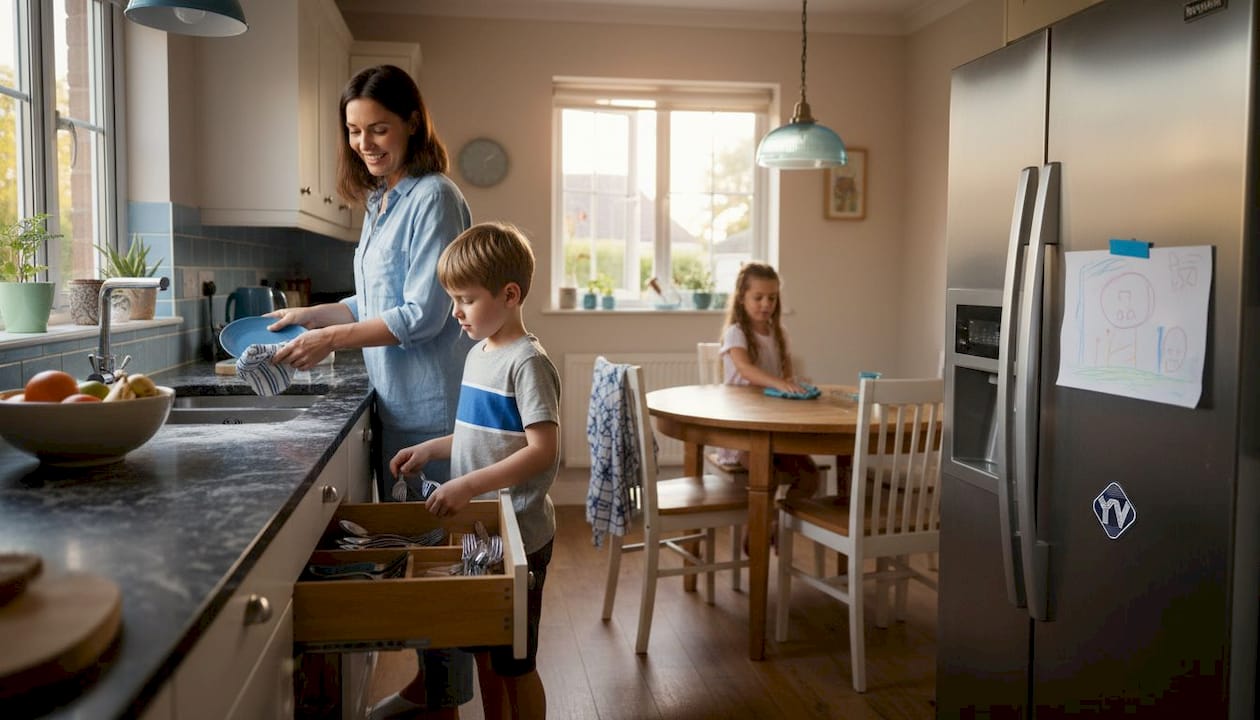
Research confirms that embedding chores into predictable daily moments helps children understand when their help is expected, which significantly reduces resistance and negotiation. When cleaning is just part of what happens after dinner or before Saturday morning cartoons, children stop seeing it as something being imposed on them and start accepting it as a simple fact of family life.
Here is a step-by-step approach for setting up a cleaning routine that actually holds together:
- Choose your anchor points. Identify two or three predictable daily moments, such as after breakfast, before dinner, and before bed, and attach specific cleaning tasks to each one.
- Create a visual schedule. For younger children, use pictures instead of words. Draw or print simple images of each task (a toy box, a plate, a toothbrush) and arrange them on a card or whiteboard at their eye level.
- Introduce it gradually. Start with just one routine anchor and one task per child. Add more only once the first habit feels natural, usually after two to three weeks.
- Do it together at first. For the first week or two, complete the routine alongside your child. Your presence signals that this is important and makes the experience feel collaborative rather than directive.
- Celebrate consistency, not just completion. Acknowledge when your child remembers to do their task without being asked. That self-initiated behaviour is exactly what you are building toward.
There is real evidence behind why this matters:
“There is empirical support that doing household chores is associated with positive developmental outcomes including academic and life-satisfaction outcomes, so chores can be more than just busy work.” Psychology Today, 2025
For a broader look at best cleaning routines that work for the whole household, not just the kids’ contributions, we have put together a practical home guide suited to Yarra Valley living conditions.
Should you use rewards or not?
After securing your cleaning routine, the question of how to motivate kids, especially around rewards, naturally arises. It is one of the most debated topics in parenting circles, and for good reason. The answer is more nuanced than a simple yes or no.
Rewards can take many forms:
- Sticker charts: Visual progress trackers that work well for younger children who enjoy watching their achievements accumulate.
- Point systems: More suited to primary-age children, where points can be exchanged for a chosen privilege or activity.
- Verbal praise: Simple but powerful, especially when it is specific. “You sorted all those books so quickly” lands better than “Good job.”
- Special privileges: Extra screen time, choosing the Friday night film, or a trip to a favourite local park as a weekend reward.
There is a genuine short-term benefit to rewards, particularly when a child is learning a new skill. Using rewards carefully as scaffolding, closely tied to the task and withdrawn gradually as competence grows, can support motivation without undermining long-term intrinsic drive.
However, the caution is real too. Reward systems for long-term habits can shift a child’s motivation from genuine responsibility to “what do I get?” thinking. When the sticker chart disappears, so does the behaviour.
“Reward systems can shift motivation toward compliance rather than genuine responsibility, even if they help in the short term or when teaching a new skill.” Good Housekeeping
The sweet spot is using rewards briefly when introducing something new and then fading them out in favour of natural consequences, such as a cleaner, more pleasant space to live in, and the personal satisfaction that comes with contributing to the family. A scheduled cleaning approach naturally reinforces this by making cleanliness feel normal rather than exceptional. And when you are approaching a bigger seasonal tidy-up, our spring cleaning checklist can help the whole family work through tasks together in a structured, satisfying way.
Our take: why genuine involvement wins over bribes
With the evidence on rewards in mind, here is our honest perspective on what really works for sustained cleaning participation. As a family-owned business that spends a lot of time in Yarra Valley homes, we see the difference between households where kids are genuinely involved and those where cleaning feels like a battle.
The most common mistake we observe is framing cleaning as something that gets done to the house rather than something the family does together. When a child sees you treating your home with care, and when they are given real tasks that actually matter, they begin to build a sense of ownership. That ownership is far more durable than any sticker chart.
Some parenting educators are direct about this: chore charts can feel transactional to children, producing surface compliance rather than genuine responsibility. The alternative they recommend is meaningful participation with real consequences and real recognition.
What we have noticed is that the families who struggle least are those who clean together, talk about why it matters, and treat their home as a shared space worth caring for. The game elements and routines described in this article are genuinely useful, but they work best when they sit inside a culture of family-friendly cleaning practices where everyone has a stake.
Fun is a means, not an end. The goal is a child who one day tidies up because they genuinely take pride in their environment, not because a timer went off.
Get expert help for a fresher, more family-friendly home
If your family is ready for a deeper clean or needs a fresh start, professional carpet and upholstery cleaning can make a remarkable difference in how your home looks, feels, and smells. Sometimes the best way to reset your cleaning routine is to begin with a truly clean baseline. When carpets are fresh and free of embedded dirt and odours, children and adults alike tend to be more motivated to maintain that standard. Find carpet cleaning near you across the Yarra Valley, including Lilydale, Mooroolbark, Healesville, and Croydon. Our professional residential cleaning service uses eco-friendly, family-safe products so you can feel confident about the environment your kids are playing in. For ongoing care between professional visits, our expert carpet care tips give your family simple, practical ways to keep things looking their best. Get in touch with our friendly local team today.
Frequently asked questions
What are the best quick games for getting kids to clean up?
Timed clean-up races, cleaning dance parties, and colour or shape sorting games are highly effective for young children. These game-like cleaning challenges keep the energy high and the task feeling like play rather than a chore.
How can I make sure chores are safe for my toddler?
Stick to very basic tasks like putting toys away, wiping low surfaces, or placing clothes in a laundry basket, always with direct supervision close by. The key is to match tasks to abilities so that toddlers experience success rather than frustration.
How often should children help with cleaning?
Daily or weekly routines work best, as predictable daily routines help children understand when their contribution is expected, removing the need to negotiate each time.
Do rewards like stickers actually help kids develop good cleaning habits?
Sticker charts may provide a short-term boost, but relying on reward systems for long-term habits can shift motivation toward compliance rather than genuine responsibility. Use them briefly when introducing a new task, then fade them out.
Recommended
- 7 Family-Friendly Cleaning Practices for a Healthier Home – Yarra Valley Carpet Cleaning
- Carpet Cleaning for Childcare Centres: Step-by-Step Guide – Yarra Valley Carpet Cleaning
- Child Friendly Carpet Cleaning: Safe Solutions for Homes – Yarra Valley Carpet Cleaning
- Is steam cleaning safe for kids? What parents must know – Yarra Valley Carpet Cleaning
- Inspirujące przykłady aktywności szkolnych dla Twojego dziecka – Nowa Szkoła Sopot