
TL;DR:
- Deep cleaning removes embedded dust, allergens, and bacteria, improving air quality and employee health.
- Proper preparation and thorough drying are essential for effective and safe office carpet deep cleaning.
- Regular spot checks and professional services help maintain carpets, extending their lifespan and appearance.
A client walks into your office, glances down, and notices carpet that’s matted, stained, and carrying the faint smell of last week’s spilled coffee. First impressions form fast, and that moment can quietly undermine confidence in your whole operation. Clean, well-maintained carpets send an entirely different message: this is a professional space where people take pride in their environment. Beyond appearances, office carpets trap dust, allergens, and bacteria at levels that affect the health and performance of everyone working in the space. This checklist walks you through every stage of a thorough deep clean, from gathering the right tools to completing your final inspection.
Table of Contents
- Why deep cleaning matters for office carpets
- Preparation: what you need before starting
- Deep cleaning office carpets: step-by-step process
- Common mistakes and final checks
- Our perspective: why most office carpet cleaning misses the mark
- Get expert help for flawless office carpets
- Frequently asked questions
Key Takeaways
| Point | Details |
|---|---|
| Deep cleaning boosts health | Deep cleaning eliminates allergens and bacteria that regular vacuuming cannot reach. |
| Preparation prevents setbacks | Gathering the right tools and supplies before starting streamlines the process and avoids delays. |
| Follow a set process | A clear, step-by-step checklist ensures thorough and consistent carpet cleaning results. |
| Avoid common mistakes | Allowing plenty of drying time and checking for hidden spots results in cleaner, safer carpets. |
| Professional help offers advantages | Expert cleaning services handle complex jobs and prolong your carpet’s lifespan with specialised care. |
Why deep cleaning matters for office carpets
Regular vacuuming is essential, but it only addresses what sits on the surface. Beneath the fibres, carpets accumulate layers of fine dust particles, skin cells, tracked-in soil, and biological contaminants that a standard vacuum simply cannot reach. Over time, this build-up affects indoor air quality and creates an environment where allergens and bacteria thrive.
The consequences show up in measurable ways. Staff who suffer from allergies or asthma often report worsened symptoms in poorly maintained office environments. Visitors and clients notice the look and smell of a carpet before they consciously register anything else. Research into carpet cleaning and productivity confirms that clean office carpets directly support better health outcomes and more focused, comfortable work.
Key reasons to prioritise deep cleaning in your office:
- Dust and allergen removal: Vacuuming captures surface debris, but steam extraction removes the fine particles embedded deep in carpet fibres that trigger respiratory issues.
- Bacteria and odour control: Foot traffic, food spills, and humidity create ideal conditions for bacterial growth. Deep cleaning sanitises fibres and neutralises the odours that regular cleaning leaves behind.
- Improved visual appeal: A clean carpet signals a well-managed workspace to every person who walks through the door, whether that’s a new employee, a visiting client, or a building inspector.
- Carpet longevity: Dirt and grit act like sandpaper on carpet fibres over time. Regular deep cleaning reduces fibre degradation and can extend carpet life by several years, saving significant replacement costs.
“Deep cleaning isn’t a luxury for office carpets — it’s the maintenance step that protects your investment and your team’s health.”
Understanding office carpet sanitation helps you appreciate why frequency matters just as much as technique. A carpet that looks acceptable to the eye may still be harbouring contaminant levels that affect air quality throughout the entire office.
Pro Tip: If you can smell the carpet before you see the problem, you’ve already let deep cleaning wait too long. Schedule based on traffic volume, not visible soiling.
Preparation: what you need before starting
A rushed deep clean with the wrong tools produces mediocre results at best. Preparing thoroughly before you start means fewer interruptions mid-process and a far more consistent outcome across your entire office floor.
Essential equipment and supplies
Review the essential tools for carpet maintenance before purchasing anything new. Having the right gear ready avoids the common mistake of attempting a deep clean with equipment that isn’t suited to the job.
| Tool | Use case | Best practice tip |
|---|---|---|
| Commercial vacuum cleaner | Removing loose surface debris before wet treatment | Use a HEPA filter vacuum to capture fine particles |
| Carpet extractor or steam cleaner | Deep cleaning fibres with hot water and solution | Allow the machine to warm up fully before starting |
| Spot treatment solution | Pre-treating stains before extraction | Apply and let it dwell for 5 minutes before agitating |
| pH-neutral carpet shampoo | Cleaning solution safe for most carpet types | Always check compatibility with your carpet’s fibre type |
| Rubber gloves and eye protection | Protecting yourself during chemical application | Non-negotiable when working with concentrated solutions |
| Wet floor and caution signage | Alerting staff to damp surfaces during and after cleaning | Place signs at every entry point to the cleaned area |
| Fans or portable dehumidifiers | Accelerating drying after extraction | Position near doorways and windows for maximum airflow |
Choosing eco-friendly cleaning supplies is especially important in enclosed office environments. Standard commercial cleaning agents can leave chemical residues that off-gas into the air long after the carpet appears dry, affecting the air quality your staff breathe all day.
Preliminary steps before you begin
- Identify every stained or heavily soiled section and mark them clearly before you start.
- Move furniture off the carpet where possible, or use furniture pads to protect legs during cleaning.
- Section off the area from staff and visitors using barriers or temporary signage.
- Check that your water source and drainage are accessible for your extractor machine.
The guidance on deep cleaning office carpets naturally recommends always performing a patch test with any new cleaning solution on an inconspicuous area before applying it broadly. This single step can prevent costly discolouration or fibre damage on expensive commercial carpet.
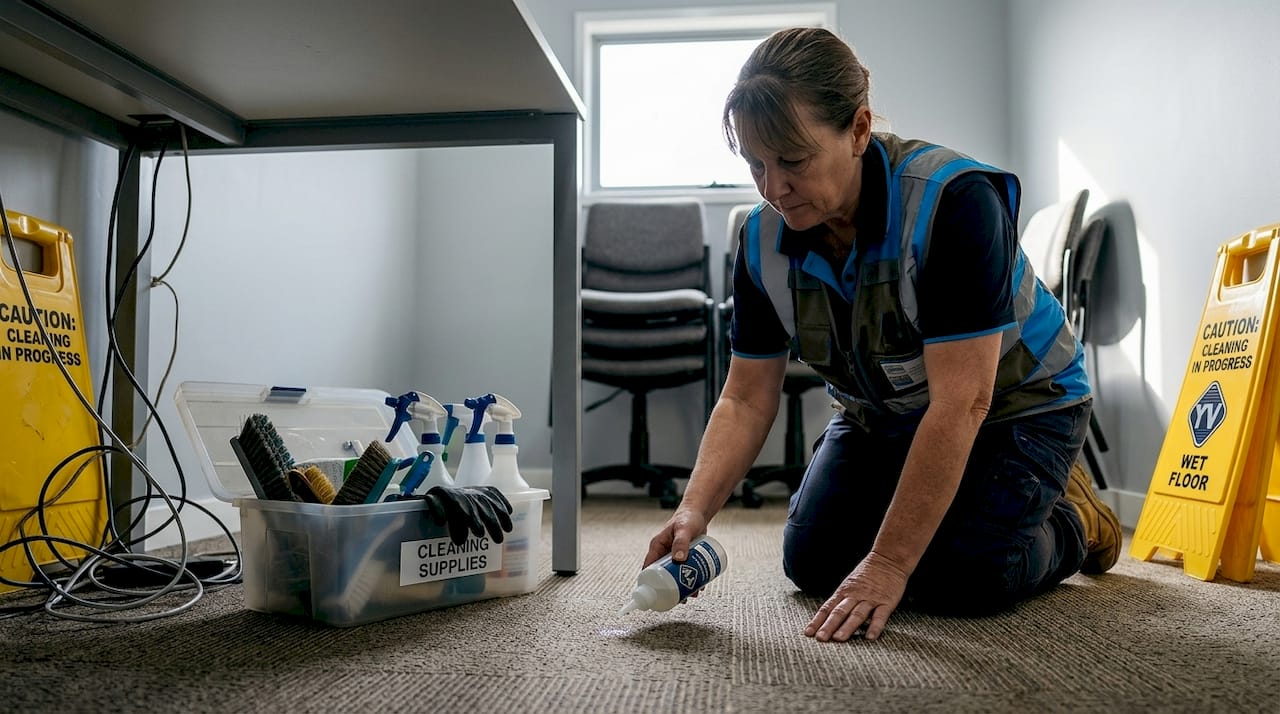
Pro Tip: Test your cleaning solution on the inside corner of a wardrobe or under a heavy piece of furniture that won’t be moved. If colour transfer or lightening occurs within five minutes, switch products before you ruin a visible section of flooring.
Deep cleaning office carpets: step-by-step process
Follow this sequence without skipping steps. Each stage builds on the one before it, and cutting corners at any point reduces the effectiveness of every subsequent step.
-
Clear the area completely. Remove all portable furniture, chairs, and floor accessories. If large desks cannot be moved, treat the accessible areas first and arrange a follow-up session for the sections underneath.
-
Dry vacuum the entire floor meticulously. Vacuum slowly in overlapping rows, both horizontally and vertically. This removes loose debris that would otherwise turn into mud when wet cleaning solution is applied. A thorough vacuum at this stage makes extraction significantly more effective.
-
Pre-treat all visible stains. Apply spot treatment to each marked stain before you begin broad extraction. Allow the solution to penetrate for at least five minutes. Agitate gently with a stiff brush to work the treatment into the fibres. This step is where most DIY cleans fail; skipping or rushing it means stains resurface once the carpet dries.
-
Apply your carpet cleaning solution. Following manufacturer guidelines, apply your chosen pH-neutral carpet shampoo either through your extractor machine’s tank or as a pre-spray. Ensure even coverage without over-saturating the carpet, which increases drying time and risks mould growth in the underlay.
-
Use your carpet extractor or steam cleaner. Work in slow, overlapping passes in one direction, then rotate 90 degrees and repeat for a second pass. The commercial carpet cleaning workflow used by professionals involves this cross-directional approach because it lifts fibres from multiple angles, extracting far more embedded soil than a single-direction pass.
-
Allow carpets to dry completely before foot traffic resumes. This is the step most office managers underestimate. Depending on ventilation and humidity, drying can take anywhere from two to eight hours. Use fans and open windows to accelerate the process. Consider scheduling deep cleans on Friday afternoons so carpets have the full weekend to dry.
-
Inspect all areas and repeat treatment on stubborn zones. Walk the entire cleaned area in good lighting before declaring the job done. Check high-traffic corridors, entry points, and spots near kitchens or coffee stations. A second extraction pass on problem areas is always better than accepting a substandard result.
A useful way to evaluate your approach is to compare methods before committing to a process:
| Feature | Traditional solvent cleaning | Eco-friendly steam extraction |
|---|---|---|
| Chemical residue | Higher residue risk | Minimal to none |
| Drying time | 4 to 8 hours | 2 to 6 hours |
| Odour after cleaning | Chemical smell possible | Fresh, neutral result |
| Effectiveness on deep stains | Moderate | High |
| Safety for enclosed office spaces | Moderate (ventilation required) | High |
| Environmental impact | Higher | Lower |
For detailed guidance on related tasks, the upholstery step-by-step cleaning process follows a similar logic and is worth reviewing if your office also has soft-furnished chairs or lounges. Consistency in your cleaning approach across all fabric surfaces produces a much more cohesive, professional environment.
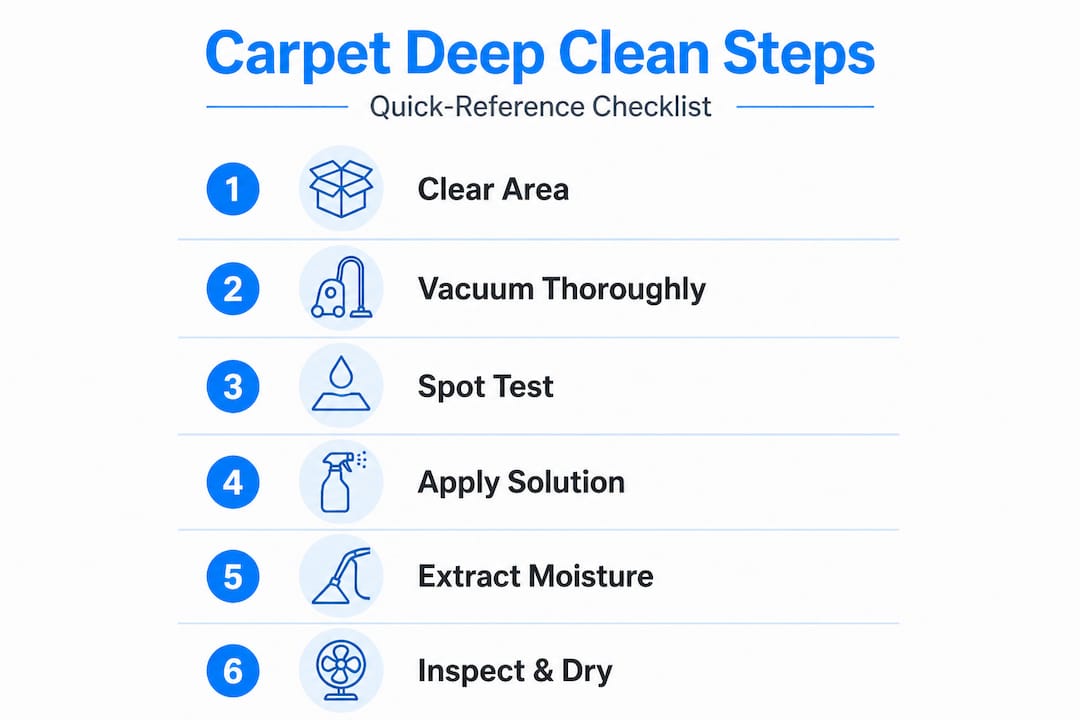
If you want a condensed reference you can print and keep on-site, the office carpet cleaning checklist summarises each stage for fast reference during cleaning days.
Common mistakes and final checks
Even experienced facilities managers make errors that undermine an otherwise solid cleaning effort. Knowing the most common pitfalls in advance means you can actively avoid them.
Common mistakes that reduce cleaning effectiveness:
- Insufficient drying time: This is the single biggest cause of post-clean odour problems and mould growth in the underlay. Never allow foot traffic on damp carpet.
- Missing high-traffic zones: Entry corridors, the path between the kitchen and main work areas, and spots in front of printers or photocopiers accumulate dirt fastest. These areas need more passes and often a second pre-treatment application.
- Skipping stain pre-treatment: Applying extraction directly over untreated stains often sets them permanently rather than removing them. Pre-treatment is not optional.
- Using too much water or solution: Over-wetting pushes moisture into the underlay and subfloor, creating conditions for mould that won’t be visible for weeks.
- Forgetting furniture legs: Metal furniture legs can leave rust marks on damp carpet. Always use plastic or foam leg protectors under any furniture placed back before the carpet is fully dry.
“Always use caution signage to prevent slips on damp carpet. A cleaning-related workplace injury costs far more than the time it takes to put up a sign.”
For your final inspection, work through this checklist before removing barriers and allowing staff back into the space. Review office carpet cleaning tips for a broader checklist you can adapt for your specific office layout. Also confirm how frequently your space should be deep cleaned by reviewing how often to deep clean based on your foot traffic levels.
Final checks before reopening:
- Surface is completely dry to the touch with no damp or cool patches
- Appearance is uniform with no visible staining or obvious traffic patterns remaining
- No lingering chemical or musty odours detected from any area of the carpet
- Furniture legs are protected and any repositioned items are stable and secure
- Signage remains in place until all sections are verified as fully dry
Our perspective: why most office carpet cleaning misses the mark
After working with commercial spaces across the Yarra Valley, the pattern we see most often is this: office managers follow a checklist, tick every box, and still end up with carpets that look mediocre within weeks. The checklist isn’t the problem. The problem is treating the checklist as a rigid ritual rather than a responsive tool.
Most business carpet maintenance routines are designed for a generic office. But your office isn’t generic. A busy reception area in Lilydale with dozens of client visits daily has completely different needs to a small back office in Healesville used mainly for storage and occasional meetings. Applying the same cleaning intensity, frequency, and product choice to both spaces is a waste of resources in one and a chronic underservice in the other.
The most overlooked task in any office carpet routine is periodic spot checks between scheduled deep cleans. A stain treated within 24 hours takes a fraction of the effort to remove compared to one left for three weeks until the next scheduled clean. Build a simple monthly walk-through into your calendar. Look for areas where foot traffic has started to compact fibres or where a fresh spill has been superficially blotted but not properly treated.
The offices with the best-maintained carpets we service are rarely the ones with the most aggressive cleaning schedules. They’re the ones where someone has taken five minutes each week to look properly at the floor and respond to what they actually see, rather than what a calendar says.
Get expert help for flawless office carpets
When the job is too large, the staining too stubborn, or your schedule too demanding to manage a deep clean properly in-house, professional support makes a measurable difference. Explore our full range of Yarra Valley carpet cleaning services to find the right solution for your commercial space. Our commercial cleaning process uses advanced extraction equipment and eco-friendly products to deliver results that in-house efforts often can’t replicate, particularly for large floor areas or heavily soiled carpets. If you want to see what’s possible before booking, take a look at our before and after carpet results from offices and commercial spaces across the region. Yarra Valley Carpet Cleaning is family-owned, locally operated, and backed by real experience across businesses throughout Lilydale, Mooroolbark, Healesville, and beyond. We’re here when your carpets need more than a checklist can deliver.
Frequently asked questions
How often should office carpets be deep cleaned?
Office carpets should be deep cleaned every 6 to 12 months, with higher-traffic spaces or those near food preparation areas requiring more frequent attention.
What is the difference between regular and deep carpet cleaning?
Regular cleaning lifts surface dirt; deep cleaning extracts hidden bacteria, allergens, and ingrained stains using intensive hot water extraction or steam methods that reach the base of the carpet fibres.
Which cleaning solutions are safest for office carpets?
Eco-friendly, pH-neutral cleaners are the safest choice for both carpet fibres and indoor air quality, leaving no harsh chemical residue that affects the people working in the space.
Can I deep clean carpets without a professional machine?
You can treat smaller areas using an eco-friendly solution, a stiff brush, and thorough rinsing, but a professional-grade extractor removes significantly more soil and moisture, producing faster drying times and better results across larger floor areas.
How do I prevent carpet mould after cleaning?
Ensure the carpet is fully dry before use by ventilating the area thoroughly, running fans, and if possible, using a dehumidifier to draw residual moisture from both the fibres and the underlay.
Recommended
- Essential Office Carpet Maintenance for a Clean Workspace – Yarra Valley Carpet Cleaning
- How to Deep Clean Office Carpets Naturally for Spotless Results – Yarra Valley Carpet Cleaning
- Office Carpet Cleaning Checklist: Your Complete Guide – Yarra Valley Carpet Cleaning
- 7 Best Office Carpet Cleaning Tips for Fresh Workspaces – Yarra Valley Carpet Cleaning
- How to clean a rental property for top guest satisfaction