
TL;DR:
- Carpets trap allergens deep within fibers, reducing airborne particles when well-maintained.
- Deep cleaning with hot water extraction removes over 90% of allergens, surpassing vacuuming.
- Regular cleaning, humidity control, and preventive measures improve indoor air quality in allergy-prone homes.
If you’ve ever been told to rip out your carpets to fix your allergies, you might want to hold off. The relationship between carpets and indoor allergens is far more nuanced than most people realise, and the popular advice to switch to hard floors isn’t always backed by the science. Carpets can trap dust, pollen, pet dander, and dust mite debris deep within their fibres, which genuinely affects indoor air quality. But here’s the part that surprises most homeowners: a well-maintained carpet can actually reduce the number of allergen particles floating in the air you breathe. This guide breaks down how it all works and what you can do about it in your Yarra Valley home.
Table of Contents
- How carpets trap and hold allergens
- Why surface cleaning isn’t enough
- Carpets vs hard floors: Which is better for allergies?
- Practical steps to reduce carpet allergens in Yarra Valley homes
- Why our approach to carpet allergens needs a rethink
- Breathe easier with expert carpet allergen care
- Frequently asked questions
Key Takeaways
| Point | Details |
|---|---|
| Carpets trap more allergens | Carpet fibres collect dust, pollen, and animal dander more effectively than hard floors. |
| Deep cleaning is essential | Ordinary vacuuming misses most embedded allergens—professional hot water extraction works best. |
| Carpets can lower airborne allergens | Properly maintained carpets may reduce allergens floating in your home’s air compared to hard floors. |
| Tailor cleaning to the season | Increase cleaning and control humidity during Yarra Valley’s pollen-heavy, humid months. |
How carpets trap and hold allergens
Think of your carpet as a dense filter sitting on your floor. Every time someone walks through the door, opens a window, or lets the dog inside, particles settle downward and get caught in the carpet’s fibres. The structure of carpet, including its pile height, density, and fibre composition, creates what researchers describe as a ‘sink’ effect for airborne particles.
According to research on airborne allergen exposure, carpets trap allergens through their fibrous structure, pile height, density, and fibre composition, making them uniquely effective at pulling particles out of the air. This is a double-edged reality. On one hand, those particles aren’t circulating in the air you breathe. On the other, they’re sitting in your floor waiting to be disturbed.
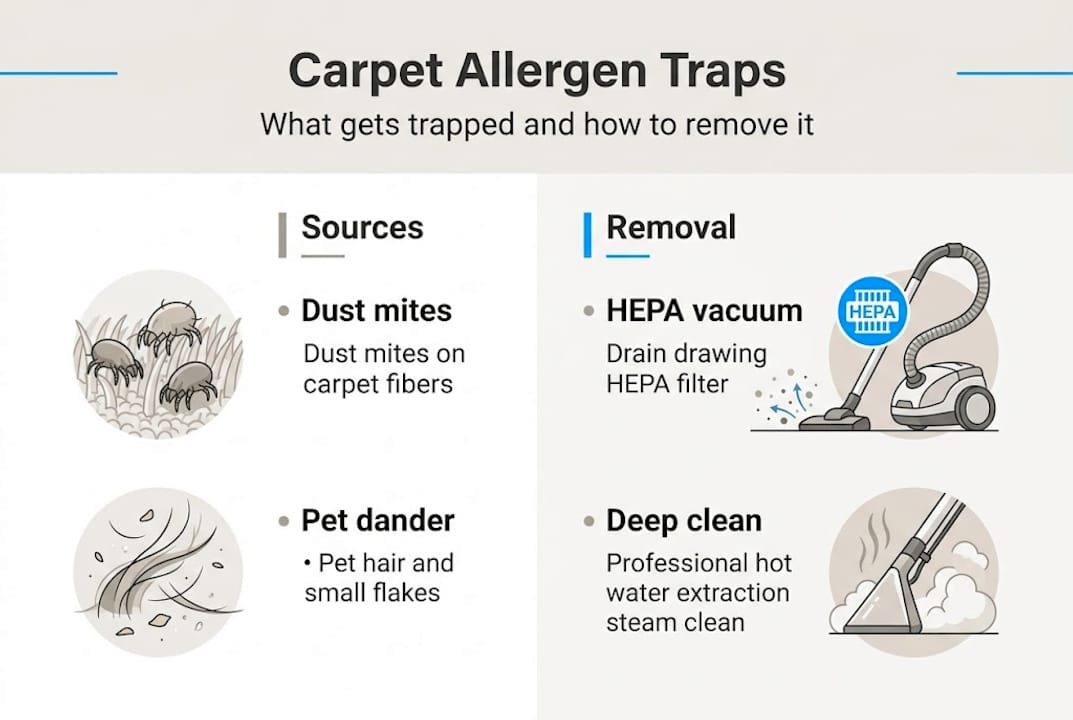
What makes this particularly relevant for Yarra Valley homes is the region’s seasonal pollen load. Spring and autumn bring significant airborne pollen, and every time that pollen drifts inside, carpet fibres catch and hold it. Studies on dust surface concentrations confirm that dust levels are measurably higher on carpets than smooth flooring due to this fibrous trapping mechanism.
Over 50% of particles trapped in carpet are under 50 microns in size. To put that in perspective, a human hair is roughly 70 microns wide. These are particles small enough to travel deep into your airways if they become airborne again.
The key variables that determine how much your carpet holds onto allergens include:
- Fibre type: Synthetic fibres like nylon and polyester tend to trap more fine particles than natural wool.
- Pile height: Longer pile captures more particles but also makes them harder to remove.
- Density: Denser carpets hold more allergens per square metre.
- Traffic patterns: High-traffic areas disturb trapped particles more frequently, releasing them back into the air.
“Carpets act as both a reservoir and a barrier. Between cleanings, they hold allergens out of the breathing zone. The problem starts when that reservoir becomes full or gets disturbed.” Understanding this balance is the foundation of smart carpet care for air quality and carpets.
Why surface cleaning isn’t enough
Knowing that carpets act as reservoirs, what does this mean for everyday cleaning habits? The honest answer is that most of us are only scratching the surface, literally.
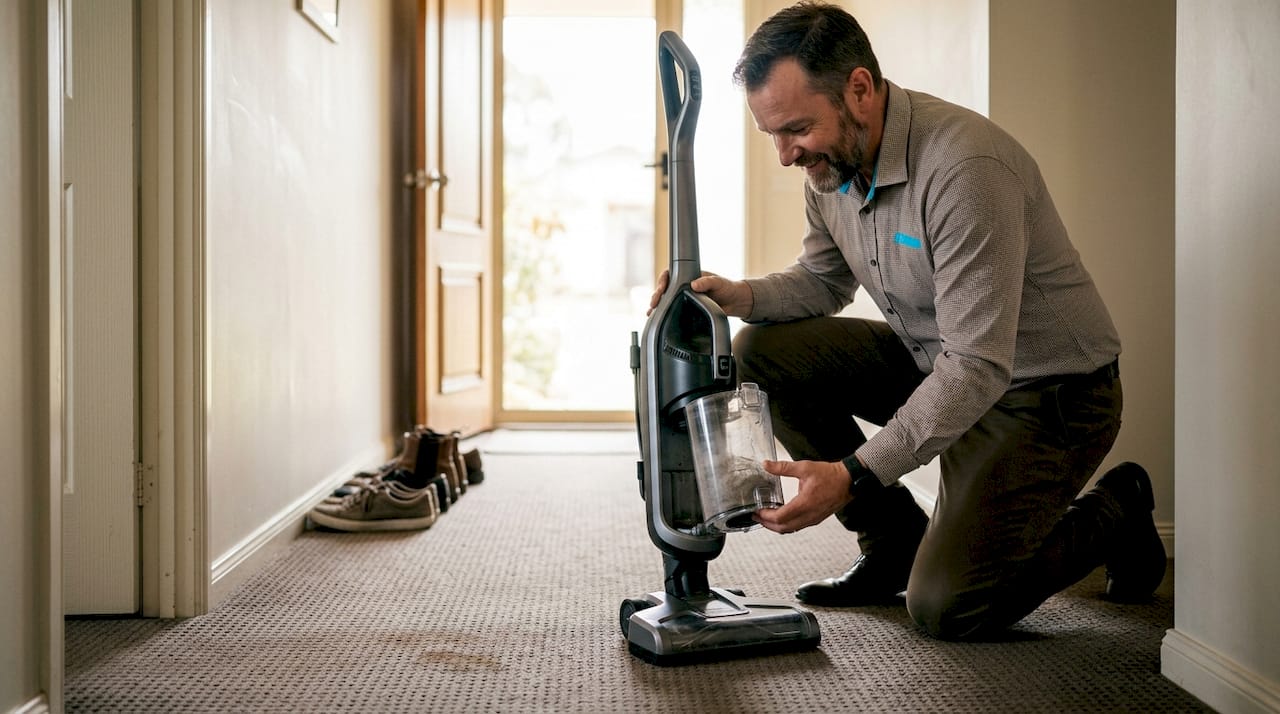
Standard household vacuums, even good ones, primarily agitate and remove particles sitting near the top of the carpet pile. They do a reasonable job on visible debris like crumbs and loose hair. But allergens don’t stay near the top. Over time, foot traffic, air movement, and gravity push them deeper into the carpet structure, all the way down to the backing.
Research on allergen levels in carpets shows that over 70% of allergens are concentrated in the base layer of carpet, well beyond the reach of most vacuum cleaners. This means that if you’re relying solely on weekly vacuuming to manage your allergy symptoms, you’re only addressing a fraction of the problem.
Here’s what tends to accumulate in those deeper layers:
- Dust mite bodies and their waste particles
- Pet dander from dogs and cats
- Mould spores, especially in humid rooms or after water exposure
- Pollen tracked in from outside
- Skin cells, which are the primary food source for dust mites
| Cleaning method | Depth reached | Allergen removal rate |
|---|---|---|
| Standard vacuum | Surface to mid-pile | 20 to 30% |
| HEPA vacuum | Mid-pile | 40 to 60% |
| Hot water extraction | Full depth to backing | 91 to 97% |
Pro Tip: If you use a vacuum without a HEPA filter, you may actually be redistributing fine allergen particles back into the air rather than removing them. Upgrade to a HEPA-rated vacuum for noticeably better results between professional cleans.
For households with allergy sufferers, this is why carpet cleaning tips for allergies consistently point toward professional hot water extraction as the most effective solution. Surface cleaning maintains appearances but deep cleaning protects your health.
Carpets vs hard floors: Which is better for allergies?
Now that we’ve seen how deeply allergens can settle in carpet, how do carpets compare to alternatives, especially with Yarra Valley’s allergy-prone seasons?
The common assumption is simple: hard floors are cleaner, so they must be better for allergies. The reality is more interesting. When you walk across a hard floor, sweep it, or even just open a door nearby, the particles sitting on that surface become airborne again almost instantly. Hard floors offer no trapping mechanism at all.
Research confirms that carpets can reduce airborne allergens compared to hard floors during disturbance events like walking or vacuuming. The carpet holds particles down rather than releasing them into your breathing zone.
That said, dust surface concentrations are measurably higher on carpets, with a median of 0.12 g/m², compared to smooth flooring. So carpets do accumulate more. The question is whether accumulation or airborne exposure is the greater health risk for you personally.
Here’s a straightforward comparison:
| Factor | Carpet | Hard floor |
|---|---|---|
| Allergen accumulation | Higher | Lower |
| Airborne allergens when disturbed | Lower | Higher |
| Cleaning depth required | Deep extraction | Surface mopping |
| Maintenance frequency needed | Weekly vacuum, 6 to 12 monthly deep clean | Regular mopping |
The choice between carpet and hard floors ultimately comes down to:
- How frequently you can commit to deep cleaning your carpet.
- Whether anyone in the household has severe asthma or a specific allergy trigger.
- The humidity levels in your home, since higher humidity accelerates dust mite growth in carpets.
- Your lifestyle, including pets, children, and how often outdoor shoes are worn inside.
For carpet cleaning and air quality, the consensus among allergy guidelines is clear: cleaning method and frequency matter more than flooring type. A well-maintained carpet in a Yarra Valley home can be just as allergy-friendly as polished floorboards, provided you stay on top of deep cleaning.
Practical steps to reduce carpet allergens in Yarra Valley homes
Understanding the science and comparisons is one thing, but what can you actually do today to improve your indoor air quality?
Yarra Valley’s climate is worth factoring into your approach. The region experiences humid summers, cool wet winters, and high pollen periods in spring and autumn. Dust mites thrive in humidity above 50%, and mould spores increase significantly after wet weather. These local conditions mean a generic cleaning schedule probably won’t cut it.
Here are the most effective strategies for reducing carpet allergens in your home:
- Vacuum more frequently during pollen season. Spring and autumn are the worst periods for airborne pollen in the Yarra Valley. Increase vacuuming to at least three times per week during these months.
- Use a HEPA-filter vacuum. Standard vacuum filters allow fine particles to pass straight through and back into the air. A HEPA-rated vacuum captures particles down to 0.3 microns.
- Control indoor humidity. Keep indoor humidity below 50% using a dehumidifier or air conditioning. This directly limits dust mite reproduction and mould growth in carpet fibres.
- Remove shoes at the door. A significant proportion of outdoor pollen and pollutants enter your home on the soles of shoes. A simple no-shoes policy makes a measurable difference.
- Schedule professional hot water extraction. This is the most impactful single action you can take. Hot water extraction reduces surface allergens by 91 to 97% and cuts airborne allergen levels by 67%.
Pro Tip: Don’t wait until your carpet looks dirty to book a professional clean. Allergens are invisible, and by the time you notice a problem with your symptoms, the carpet’s base layer is already heavily loaded.
For a full breakdown of best carpet cleaning tips specific to allergy management, or to understand how cleaning connects to reducing asthma triggers, there’s solid guidance available. Most allergy specialists also align with recommendations for cleaning frequency that suggest professional cleaning at least once a year, with more frequent cleans for allergy-prone households.
Why our approach to carpet allergens needs a rethink
After years of working in Yarra Valley homes, we’ve noticed a pattern. Homeowners either dismiss carpets entirely, convinced they’re a health hazard, or they vacuum occasionally and assume that’s enough. Both extremes miss the point.
The conventional wisdom that hard floors are automatically healthier is an oversimplification that doesn’t hold up under scrutiny. And the idea that a weekly vacuum solves the allergen problem ignores everything we know about how deep allergens actually sit in carpet.
What genuinely works is a layered approach: frequent surface cleaning, humidity control, and regular professional deep extraction. Carpets managed this way can actively support better health benefits of carpet cleaning by keeping allergens locked out of the air you breathe.
The uncomfortable truth is that neglected carpet is a health risk, but well-maintained carpet is not. The difference between the two is a consistent, science-informed cleaning routine that accounts for your local climate and the specific allergens your household faces. That’s the standard we hold ourselves to, and it’s the standard worth applying to every Yarra Valley home.
Breathe easier with expert carpet allergen care
If you’re ready to move from understanding to action, Yarra Valley Carpet Cleaning is here to help. Our team specialises in carpet allergen removal services using professional hot water extraction that reaches the full depth of your carpet, targeting the allergen load that vacuuming simply cannot shift. We understand the Yarra Valley’s unique seasonal conditions, from spring pollen peaks to humid summers, and we tailor our approach accordingly. Whether you’re in Lilydale, Healesville, Mooroolbark, or anywhere across the region, our family-owned team brings genuine local knowledge to every job. To find a local carpet cleaning expert who knows your area, get in touch today and take the first real step toward a healthier home.
Frequently asked questions
What types of allergens do carpets trap most?
Carpets are particularly effective at trapping dust, pollen, pet dander, and dust mite debris due to their fibrous structure and pile density. These particles settle downward and become embedded in the carpet fibres rather than remaining airborne.
Is vacuuming enough to remove allergens from carpets?
Vacuuming helps manage surface-level particles but cannot reach the deep layers where over 70% of allergens are typically concentrated. Professional hot water extraction is needed to address the full allergen load.
How often should I deep clean my carpets for allergies in Yarra Valley?
Aim for professional deep cleaning every 6 to 12 months, and increase the frequency during Yarra Valley’s high-pollen seasons in spring and autumn. Cleaning frequency recommendations suggest more frequent cleans for households with allergy sufferers or pets.
Does hot water extraction really reduce allergens in carpets?
Yes. Hot water extraction removes 91 to 97% of surface allergens and reduces airborne allergen concentrations by 67%, making it the most effective carpet cleaning method for allergy management.
Recommended
- Impact of Clean Carpets on Health Explained – Yarra Valley Carpet Cleaning
- Air Quality and Carpets: Complete Guide for Homes – Yarra Valley Carpet Cleaning
- The Essential Guide to Health Benefits Carpet Cleaning – Yarra Valley Carpet Cleaning
- 7 Expert Carpet Cleaning Tips for Allergies at Home – Yarra Valley Carpet Cleaning